
When the Workplace Becomes Digital: Why Human Experience Still Matters
 I have worked in heavy industry for almost twenty years. During that time, I have seen technology become a much bigger part of everyday work. Computers were already important when I started, but today much more information is collected digitally, processes are monitored by computer systems, and workers increasingly depend on data when making decisions.
At the same time, I am studying Computer Science, which gives me another perspective on this development. I understand why companies want to use more automation, data and artificial intelligence. These technologies can make work more efficient and, more importantly, safer. However, my experience from industry has also taught me something important: a computer system is a very useful tool, but it should not automatically be treated as if it is always right.
Digitalization has improved the workplace
There are many good reasons for digitalizing industrial workplaces. Workers can access information faster, processes can be monitored continuously, and computer systems can detect changes that would be difficult for a person to follow all the time. Automation can also take over repetitive or dangerous tasks.
This is particularly important in heavy industry, where safety is always a major concern. The International Labour Organization (2025) points out that automation, robotics and smart monitoring systems can reduce workers' exposure to hazardous conditions, prevent injuries and improve working conditions.
From my own experience, I see technology as something that should help workers make better decisions. Having more information available is generally an advantage. The problem begins when having information from a computer becomes the same as assuming that the computer must be correct.
What happens when the computer is wrong?
People sometimes forget that digital systems still depend on sensors, software, data and people. Sensors can fail. Data can be incomplete. Software can contain errors. A system may also correctly report the information it has received while still not showing the complete situation in the real workplace.
This is where human experience remains extremely important.
After working with the same processes for many years, a worker develops knowledge that is difficult to describe in a manual or computer program. Sometimes something simply does not look or behave normally. An experienced worker may recognize this before a system reports a problem.
This does not mean that human judgement is always better than technology. People also make mistakes. Instead, I believe the strongest approach is to combine both. Computers are extremely good at processing large amounts of information, while experienced workers understand the real environment in which that information is being produced.
The ILO (2025) has raised a similar concern, warning that over-reliance on AI and automation can reduce human oversight and potentially introduce new occupational safety risks.
Are we losing knowledge?
Another question interests me even more. What happens to professional experience when technology increasingly tells workers what to do?
Imagine a new employee entering a workplace where a digital system identifies a problem and immediately recommends a solution. This can make training easier and help the employee avoid mistakes. But if the system always provides the answer, will the employee eventually understand why that answer is correct?
This could become an important challenge for future workplaces. Someone can become very good at operating a system without developing the same understanding of the underlying process.
The difference may not matter while everything works normally. It becomes important when something unexpected happens or when the digital system itself fails.
For this reason, digitalization should not only focus on making work easier. Companies should also think about how knowledge and experience are transferred to new generations of workers.
Artificial intelligence takes this further
Artificial intelligence makes this discussion even more interesting. Traditional computer systems mostly collect, calculate and display information. AI systems can go further by recognizing patterns, making predictions and recommending actions.
That creates enormous possibilities for industry. AI may help identify problems earlier, improve maintenance, analyze safety risks and support workers when making complicated decisions. The ILO has also emphasized the potential of digital technologies to improve occupational safety while stressing that workers need training and involvement when new technologies are introduced.
But there is an important question: what happens when an AI system recommends one action while an experienced worker believes that action is wrong?
The answer cannot simply be that the computer always wins. It also cannot be that experience should always override data. We need workplaces where people understand enough about technology to question it when necessary, and where technology provides enough useful information to challenge human assumptions when they may be wrong.
Technology should support people
After almost twenty years in industry and now studying Computer Science, I do not see the future as competition between workers and computers. Technology has already improved many parts of working life, and AI will probably accelerate this development.
The challenge is to make sure that while our systems become smarter, the people using them do not stop thinking.
A good digital workplace should use the strengths of both. Computers can monitor thousands of data points, recognize patterns and process information faster than any person. Humans bring experience, context, responsibility and the ability to recognize when something simply does not make sense.
Digital development should therefore not remove human judgement from the workplace. It should give people better tools with which to use it.
Author: Roman Svec, nemandi við Háskólann í Reykjavík
References
- International Labour Organization. (2025). Revolutionizing health and safety: The role of AI and digitalization at work. International Labour Organization. https://www.ilo.org/publications/revolutionizing-health-and-safety-role-ai-and-digitalization-work
- International Labour Organization. (2025, April 28). Harnessing the digital revolution to build safer, healthier workplaces. International Labour Organization. https://www.ilo.org/resource/statement/harnessing-digital-revolution-build-safer-healthier-workplaces
Blaðið Tölvumál
Skil á efni
Leita í vefútgáfu Tölvumála
Um Tölvumál
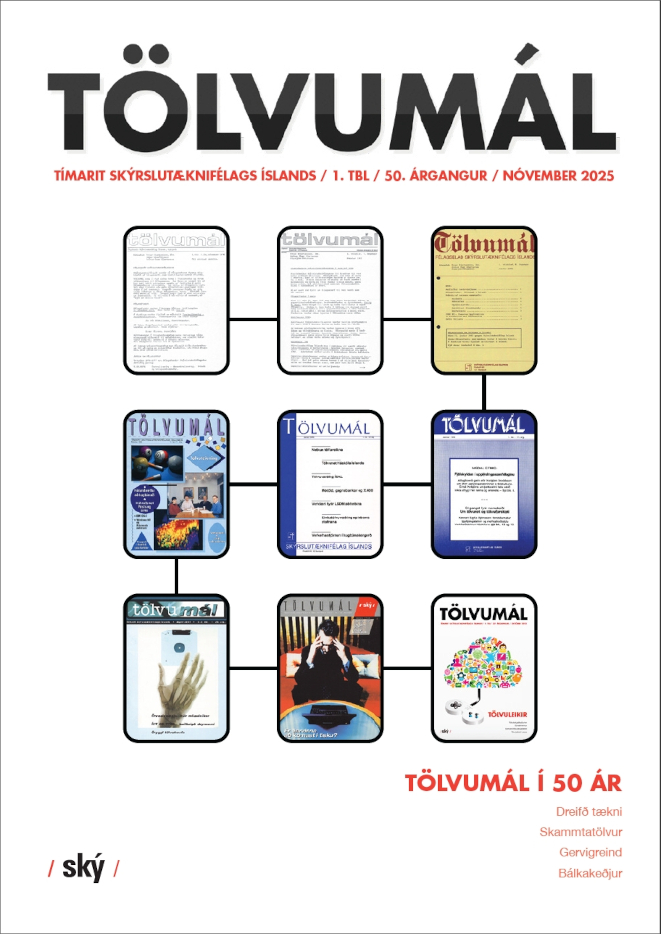
Tölvumál - tímarit Skýrslutæknifélags Íslands er óháð tímarit um tölvutækni og hefur verið gefið út frá árinu 1976.
Vefútgáfa Tölvumála birtir vikulega nýja grein á vef Ský og árlega er gefið út veglegt prentað tímarit undir nafninu "Tölvumál" þar sem fjallað er um tölvutækni frá ýmsum sjónarhornum og er þema blaðsins jafnan valið snemma árs og útgáfa að hausti.
Ritnefnd Ský sér um að afla efni í Tölvumál og geta allir sem áhuga hafa sent inn efni.